AI SLD to BOM: How Artificial Intelligence Converts Single Line Diagrams into Bills of Materials
Upload a Single Line Diagram and automatically generate a structured Bill of Materials in minutes — how AI identifies components, extracts specifications, and prepares a ready-to-review BOM.
Every electrical panel project begins with an idea, but it is the Single Line Diagram (SLD) that transforms that idea into an engineered solution. The SLD acts as the blueprint of an electrical system, defining how power flows, which protection devices are required, and how equipment is interconnected.
For decades, converting a Single Line Diagram into a Bill of Materials (BOM) has been one of the most time-consuming tasks in electrical engineering. Estimation engineers manually inspect drawings, identify symbols, calculate quantities, select components, verify ratings, and prepare quotations. While this process works, it often consumes valuable engineering hours and increases the risk of costly mistakes.
Artificial Intelligence is changing this traditional workflow.
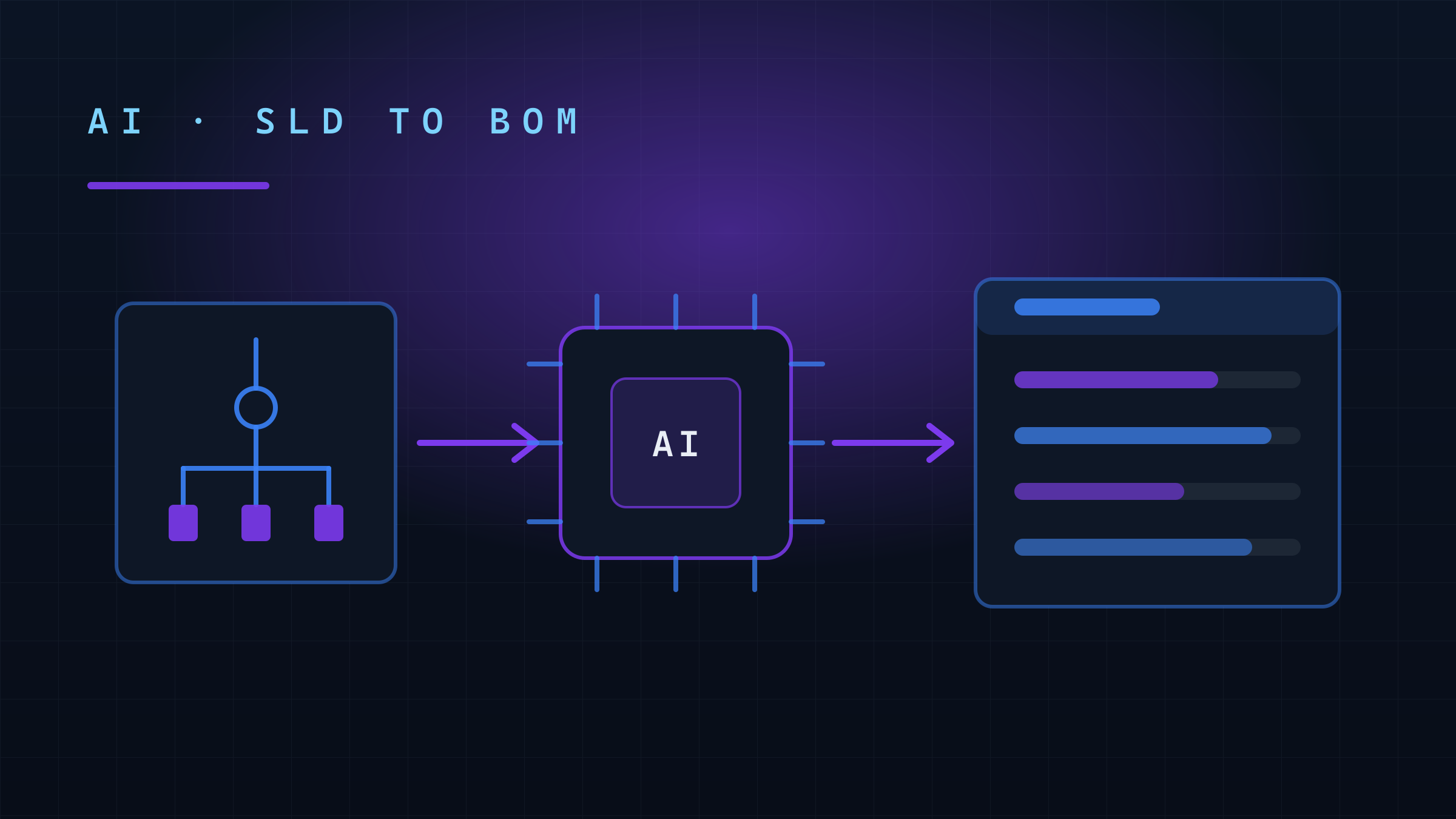
With AI SLD to BOM technology, engineers can upload a Single Line Diagram and automatically generate a structured Bill of Materials in just a few minutes. Instead of manually interpreting every symbol, AI identifies electrical components, extracts technical information, organizes the data, and prepares a ready-to-review BOM.
For panel manufacturers, EPC contractors, consultants, OEMs, and estimation engineers, this technology delivers significant improvements in productivity, quotation speed, and estimation accuracy.
In this guide, you'll discover how AI SLD to BOM works, why it matters, and how it is becoming one of the most valuable innovations in modern electrical panel estimation.
What is AI SLD to BOM?
AI SLD to BOM is an intelligent engineering workflow that automatically converts a Single Line Diagram (SLD) into a detailed Bill of Materials (BOM) using Artificial Intelligence, computer vision, and electrical engineering logic.
Instead of manually identifying every component shown in an electrical drawing, AI analyzes the diagram and recognizes the devices required to build the panel.
A complete AI workflow typically includes:
- Reading electrical drawings
- Detecting electrical symbols
- Identifying components
- Extracting technical specifications
- Calculating quantities
- Generating a structured BOM
- Preparing estimation data for quotations
The generated BOM becomes the starting point for engineering validation, procurement planning, and customer quotations.
Understanding Single Line Diagrams
A Single Line Diagram is a simplified representation of an electrical power distribution system.
Rather than showing every conductor individually, the SLD uses standardized electrical symbols to represent equipment and their connections.
An SLD commonly contains:
- Air Circuit Breakers (ACBs)
- Molded Case Circuit Breakers (MCCBs)
- Miniature Circuit Breakers (MCBs)
- Contactors
- Overload Relays
- Current Transformers (CTs)
- Potential Transformers (PTs)
- Energy Meters
- Busbars
- Capacitor Banks
- Protection Relays
- Terminal Blocks
- Control Components
For experienced engineers, reading these diagrams is routine—but doing it manually for every project takes considerable time.
What is a Bill of Materials (BOM)?
A Bill of Materials (BOM) is a structured list of every component required to manufacture an electrical panel.
It includes essential information such as:
- Component Name
- Manufacturer
- Product Code
- Current Rating
- Voltage Rating
- Quantity
- Unit of Measurement
- Unit Price
- Total Cost
- Technical Remarks
Without a complete and accurate BOM, procurement, manufacturing, and project costing become difficult.
Even a single missing component can delay production or affect project profitability.
Why Manual SLD to BOM Conversion Is Challenging
Although many companies continue using spreadsheets and manual engineering practices, the process presents several operational challenges.
1. Time-Consuming Analysis
Engineers spend hours reviewing drawings, interpreting symbols, and preparing BOMs manually.
For complex industrial panels, this process may take an entire working day.
2. Human Errors
Manual estimation increases the likelihood of:
- Missing components
- Incorrect quantities
- Duplicate entries
- Wrong device ratings
- Incomplete accessory lists
Even small mistakes can affect the final quotation and manufacturing process.
3. Inconsistent Documentation
Different engineers often prepare BOMs using different formats.
This inconsistency creates confusion during procurement and production.
4. Repetitive Work
Many projects share similar electrical designs.
Yet engineers repeatedly perform the same identification and documentation tasks from scratch.
How AI SLD to BOM Works
Modern AI systems combine computer vision, machine learning, and engineering rules to automate the conversion process.
The workflow generally consists of five key stages.
Step 1: Upload the Single Line Diagram
The process begins by uploading the electrical drawing into the software.
Most modern platforms support:
- PNG
- JPG
- TIFF
- CAD exports
The software prepares the document for analysis without requiring manual preprocessing.
Step 2: AI Recognizes Electrical Symbols
Once uploaded, Artificial Intelligence scans the drawing and identifies standard electrical symbols.
Depending on the software capabilities, AI can recognize:
- MCCBs
- MCBs
- ACBs
- Contactors
- Thermal Overload Relays
- Energy Meters
- Current Transformers
- Push Buttons
- Selector Switches
- Indicating Lamps
- Terminal Blocks
- Protection Devices
Instead of engineers manually identifying every symbol, AI performs the initial detection within seconds.
Step 3: Extract Technical Information
After identifying each symbol, AI extracts engineering information associated with every component.
This may include:
- Current Rating
- Number of Poles
- Frame Size
- Voltage Rating
- Device Category
- Circuit Number
- Quantity
- Application
This information becomes the foundation of the generated Bill of Materials.
Step 4: Generate a Structured BOM
The software organizes all extracted information into a structured BOM.
A typical BOM contains:
| Field | Example |
|---|---|
| Component | MCCB |
| Manufacturer | ABB |
| Rating | 250A |
| Poles | 4 Pole |
| Quantity | 2 |
| Description | Incoming Protection |
Instead of creating spreadsheets manually, engineers receive a ready-to-review document.
Step 5: Engineering Validation
Artificial Intelligence accelerates the process—but engineering expertise remains essential.
The estimation engineer reviews:
- Component selection
- Technical compliance
- Customer specifications
- Optional accessories
- Manufacturer preferences
This validation step ensures every BOM meets project requirements before quotations are generated.
Why AI is Becoming Essential for Panel Builders
The electrical industry is experiencing increasing pressure to deliver quotations faster while maintaining engineering quality.
Customers now expect:
- Faster responses
- Competitive pricing
- Accurate BOMs
- Shorter project timelines
Companies relying entirely on manual estimation often struggle to keep pace with these expectations.
AI SLD to BOM enables engineering teams to reduce repetitive work while improving consistency across projects.
Estimate your next panel faster
Turn your single-line diagram into a priced Bill of Materials in minutes with Switchonomy.